
#blackoutnotes [Ukraine]
600,000 people have already left Kyiv. Today we got a message from a friend - cold, realism and resilience. "Our foes will stop at nothing to inflict more suffering on Ukrainians - while they can."

[Editor’s note: On January 21, Kyiv’s Mayor, Vitali Klitschko, urged the city’s inhabitants to “leave if you can.” 600,000 have already left these last two weeks since Russia intensified its attack on the city’s energy infrastructure. The mayor says that the constant Russian attacks are pushing the city towards “a humanitarian catastrophe.” Temperatures are plunging to as low as –18°C (0°F). According to Klitschko, “the situation is critical with basic services – heating, water, electricity. Right now, 5,600 apartment buildings are without heating.” This morning, President Zelenskiy said that one million people in Kyiv are now without power. The city’s authorities have now have been forced to drain the city’s central heating and water system to prevent pipes from freezing and bursting. A couple of days ago, Ukraine’s Minister of Energy, Denys Shmyhal, said that “there is not a single power plant in Ukraine that has not been hit by the enemy during the war.”]
Today we received this from a dear, long-term friend in Kyiv:
BY OLEKSIY KURKA, resident of Kyiv, works in diplomacy and policymaking
I’ve written about Russian attacks so many times that the words no longer convey any new meaning, muted by repetition. But friends abroad cared to check in with me after last night, so here is an update.
As of this hour, only a fraction of the capital has electricity. I’ve been without power for about 24 hours now; others for much longer. It isn’t clear when it might return.
The heating is also off. The building is gradually cooling down. Soon I’ll be breathing out vapour, like some of my friends. Those living through ‘no-heat’ situations for longer - such as those near the front lines - are now camping out in their flats. It’s 5-7°C warmer inside a tent inside your flat.
The attack caused massive disruptions to public transport. Segments of the Metro I use to commute were closed due to electricity shortages. Many, myself included, had to stay and work from home.
My portable power station is gradually running out. Not having a predictable source of power is beginning to worry me more. I can predict one thing: our foes will stop at nothing to inflict more suffering on Ukrainians - while they can.
On a brighter note, I found and successfully installed a solution to the lack of internet at home. It’s an external antenna that catches and amplifies signals from nearby towers. Even during prolonged outages, I have about 15-20 Mbps, which is brilliant.
As for the power, I was inspired by my neighbour who took a mini petrol generator out to the courtyard and recharged his upper-floor flat via an extension lead. Now I fancy having the same system - and solar panels, for when there’s more daylight. Anything that minimises energy dependence is a win.
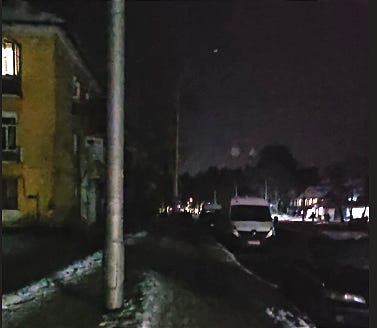
I went for a walk on the slippery, ice-clad streets of my district in an off-grid darkness that once again revealed the starred heavens. Most businesses and shops are running off generators, their light bulbs making up for the absence of proper street lights, coupled with the headlights from cars. This is how we see. That, and the torches in our hands.
Earlier today, we chatted with a visiting colleague who asked many questions about life these days. I made the point that a war of attrition forces things upon you that you’d otherwise never have thought you’d need.
But when it happens a few times, you spot the trend and start thinking even more creatively about what is yet to come. Do I need to consider satellite internet now, or are the mobile towers maintained well enough for me to avoid rushed decisions and unnecessary costs? Thinking ahead and learning from others makes the unpredictability a tiny bit more predictable, as it were.
Do I plan to leave Kyiv because of these ‘inconveniences’? I said a long time ago that there are two conditions for me to make such a significant decision: when there is no drinking water, and when the prospect of Russian occupation looms larger.
The first is not yet a reality for Kyiv, and I hope it never will be. The latter is no longer a reality, thanks to the Ukrainian army and our partners who provide Ukraine with air defence, long-range, and other weapon systems.
One more thing: Even if I leave the place, it’s only to come back.
Thank you for sharing your experience with us. For other readers of this post, I've collated a series of reports from Ukrainians talking about how they are coping with the freeze: https://annabowles.substack.com/p/how-not-to-freeze-to-death-part-1
Powerful testimoney from Oleksiy. The detail about camping in tents inside flats to stay warm realy cuts through all the abstract war coverage we usually get. His two conditions for leaving (no water, imminent occupation) frame resilience not as stubborn heroism but as calculated survival math. Been following energy infrastructure targeting for awhile now and its clear this is textbook asymetric warfare.